
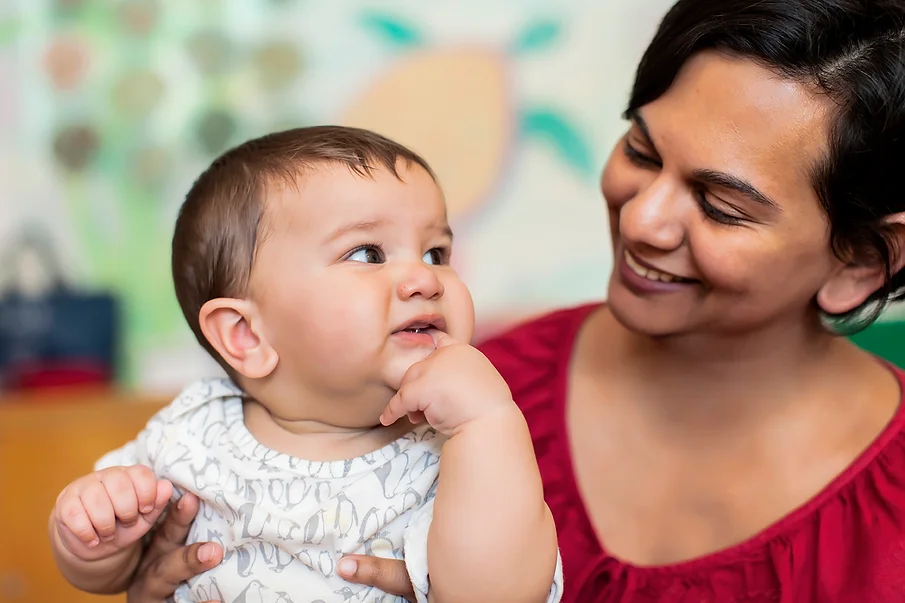
Attachment, Attunement, and Easing Separation Anxiety in Babies and Toddlers
By Ofra Sharp and Ma’ayan Hamilton / October 2023
In our previous blog, Nurturing Emotional Intelligence in Children, we looked at EQ in children and how we can nurture this essential trait. In this week’s blog, we’re shifting our focus to attachment, attunement, and the ever-common issue of separation anxiety in babies and toddlers. We’ll explore what these concepts mean for you and your little ones, and how they influence your child’s emotional growth.
Why Attachment Matters
Attachment is about the special bond between a child and their primary caregiver. It’s the deep, emotional connection that makes a child feel safe and loved. In the early weeks and months of life, this bond forms through comforting contact and physical closeness between the baby and their primary caregiver.
Psychologists often stress how crucial this close physical attachment is for a child’s future relationships. When children feel cared for and loved, it sets a strong emotional foundation for them. They learn to express themselves, recognize their emotions, and communicate using words. This emotional intelligence grows with them, helping them have healthier relationships throughout life.
The Importance of Nurturing Physical Contact
Newborns and infants rely entirely on their caregivers for survival. So, physical contact—those cuddles and soothing touches—is their lifeline. Not only does it provide comfort and closeness, but it’s also essential for their brain and nervous system development.
Here are some incredible benefits of comforting physical contact for babies:
- Releases ‘feel good’ endorphins in babies
- Boosts intellectual development
- Aids in digestion
- Helps underweight babies gain weight
- Improves blood circulation
- Reduces stress hormones
Without appropriate and comforting touch, babies may struggle to thrive. There is also evidence showing that regular baby massage can help underweight infants gain weight and improve their overall health and development.
The Significance of Attunement
Attunement is the ability to be in tune with your baby’s needs and experiences. Your role as a parent or caregiver is to understand and respond to your child’s emotions. This deepens their attachment to you.
Attunement isn’t about mimicking your baby’s expressions; it’s about responding thoughtfully and sensitively. Babies may not have the use of words yet, but they’re highly perceptive and can sense your genuine emotional state.
Sensitive babies can tell if your emotional expressions are real or feigned. Attunement involves letting your baby lead, responding with care, and maintaining a harmonious connection.
In attunement interactions, it is important to not only follow your baby’s initiation of eye contact, but also allow them to temporarily pause contact and look away when they need to.
For example your baby may make eye contact with you for a few moments, you will smile at them lovingly and your baby will hold eye contact until it reaches a certain level of intensity, and then they will break eye contact and move on to look at something else. Ideally you should allow your baby to do this without trying to draw their attention back to you. Allowing the natural flow and rhythm of your child’s curiosity to look away allows for a ‘cooling down’ period for your baby.
The anxious parent may react with alarm or distress when their baby breaks eye contact. They may try to call her baby’s attention back to them, to try to stimulate another interaction. Their baby will then be drawn back into an interaction with the anxious parent without having this ‘cooling down’ period in which their baby’s nervous system can naturally recalibrate before they bring themselves back to making eye contact of their own desire.
Repeated interactions of this nature can result in a child who themselves develops an anxious disposition, and who also as they get older will struggle to be in touch with their own natural rhythms or needs. The child attunes to the anxious parent’s psychological and emotional state and adapts accordingly, and in the long term may even develop an anxious attachment style into their adult years.
Similarly, a depressed caregiver may avoid all eye contact with their baby. Their baby is then deprived of their need for closeness and loving eye contact. With this repeated over time, this baby will start to avoid making eye contact themselves and may develop an internalised sense of feeling alone, resulting in avoidance of closeness in further social interactions – an avoidant attachment style.
Attunement is about attending to your baby’s needs for love, attention, food, warmth, comfort, and safety. But importantly, it is also about a deep level of emotional and psychological connection which is the result of a harmonious connection between the infant and caregiver.
Attunement is also about communicating a consistent message of love and acceptance through your words, voice, body language and eye contact, and moving to the flow and rhythm of your baby’s needs for interaction and engagement.
Understanding Separation Anxiety
Despite your best efforts, it’s almost certain that your child will experience separation anxiety at some point. This is entirely normal and typically occurs between 6 months and 2.5 years. It’s actually a sign of your child’s growth and development.
Separation anxiety is when your baby or toddler becomes distressed when separated from you, their primary caregiver. Since they are too young to express themselves verbally with words, they might cry, get upset, or withdraw. This is your child’s way of asking: Where have you gone? How will I manage without you? Will you come back?
As your child gets older, with the development of their language and verbal skills, they become better at answering these questions themselves, and their separation anxiety lessens, usually by around the age of 3 years.
How to Help Your Child Manage Separation Anxiety
Here are some strategies to help your child cope with separation anxiety:
- Minimize unnecessary time alone for your child. If you must leave them, talk about your departure and return. This builds trust.
- Give your child a warning 10-15 minutes before leaving. Allow them to express their feelings. Be present and offer comfort.
- Transitional objects, like a favorite toy or blanket, can provide comfort. Allow your baby and toddler to have and use their transitional objects. Don’t worry about your child becoming too dependent on them; they’ll naturally let go when they’re ready.
- Communicate with your baby from when they are born. Tell them where you are going, what you are doing and when you will be back. Use your words to reassure them by saying things like “in your heart always know that I am coming back to you”. Even if you think your baby or toddler is too young to understand you, we believe that it is still very important because they are taking in more than we may realise.
It’s natural for your child to face emotional challenges like separation anxiety, but as a parent, you play a vital role in helping them build resilience. You can offer reassuring words like, “I know it’s tough, but I’ll be back, and I believe you can handle this.” This kind of support helps your child feel capable and confident in facing discomfort, which is crucial for their personal growth.
It’s equally important for parents to manage their own anxiety when leaving their child. If you are anxious, your child will sense it and may start to feel more fearful and insecure in your absence, intensifying their separation anxiety. Your emotional state can significantly influence how your child perceives the situation.
While it can be tough to witness your child grappling with uncomfortable emotions, remember that you can validate their feelings by acknowledging what they’re going through. But also remember that it is beneficial to show them that they can navigate these emotions and situations successfully. This approach helps them feel understood while also building their confidence to handle life’s challenges.
Conclusion
In conclusion, attachment and attunement are integral aspects of your child’s emotional development. By nurturing these connections and understanding their needs, you’re setting the stage for your child to grow into an emotionally intelligent and secure individual.
Remember that separation anxiety is a normal part of development and that by helping your child navigate these difficult and uncomfortable experiences, you are helping to create resilience and belief in themselves for the rest of their lives.
About the authors
Ofra Sharp
Ofra Sharp is the founder and owner of Little Acorns PlayGroup and Time2gether Activity Workshops. Ofra has many years of experience working with children of different ages, and their families. Ofra has a deep knowledge and understanding of the importance of early childhood development. Her qualifications include:
FDE Junior Primary (CCOE, UCT)
Advanced Play Therapy (Red Shoe)
Counselling 1 and 2, and trauma debriefing certificates (FAMtrac)
Ma’ayan Hamilton
Ma’ayan is a co-owner of LIttle Acorns PlayGroup where she is also involved as a teacher assistant. Ma’ayan qualified with a Bachelor of Science in Occupational Therapy in 2008, after which she furthered her studies as a TRE provider. Ma’ayan has a deep understanding of early childhood development, as well as the psychosocial needs of young children. Ma’ayan has three children of her own and has many years of hands-on experience with young children. Her qualifications include:
B.Sc. Occupational Therapy (University of Cape Town)
TRE provider (TRE Global Certification Training)